Sign in or Register
0
Add Listing
    • Homepage
    • Projects
    • Professionals
    • Business
    • Jobs
    • Blog
    • Shqip
    Add Listing

    MODERNIST CHURCH ARCHITECTURE

    • Permbajtja
    • prev
    • next
    • prev
    • next

    When thinking of religion in general, modern doesn’t usually come to mind, does it? Just because religion is steeped in tradition doesn’t mean that they can’t be practiced or appreciated in modern structures. From the scale and ambition of Europe’s grand cathedrals to humble roadside buildings turned into places of spiritual retreat, church architecture has always been a fertile field for artistic expression and technological innovation. And while the form is literally thousands of years old, it doesn’t mean that new spins on established forms can’t continue to amaze.

    In the 20th century, the use of new materials, such as steel and concrete, has had an effect upon the design of churches. The history of church architecture divides itself into periods, and into countries or regions and by religious affiliation. In this article we will focus on the churches of modernist architecture. Here are some of our favorites:


    Photo by Gili Merin

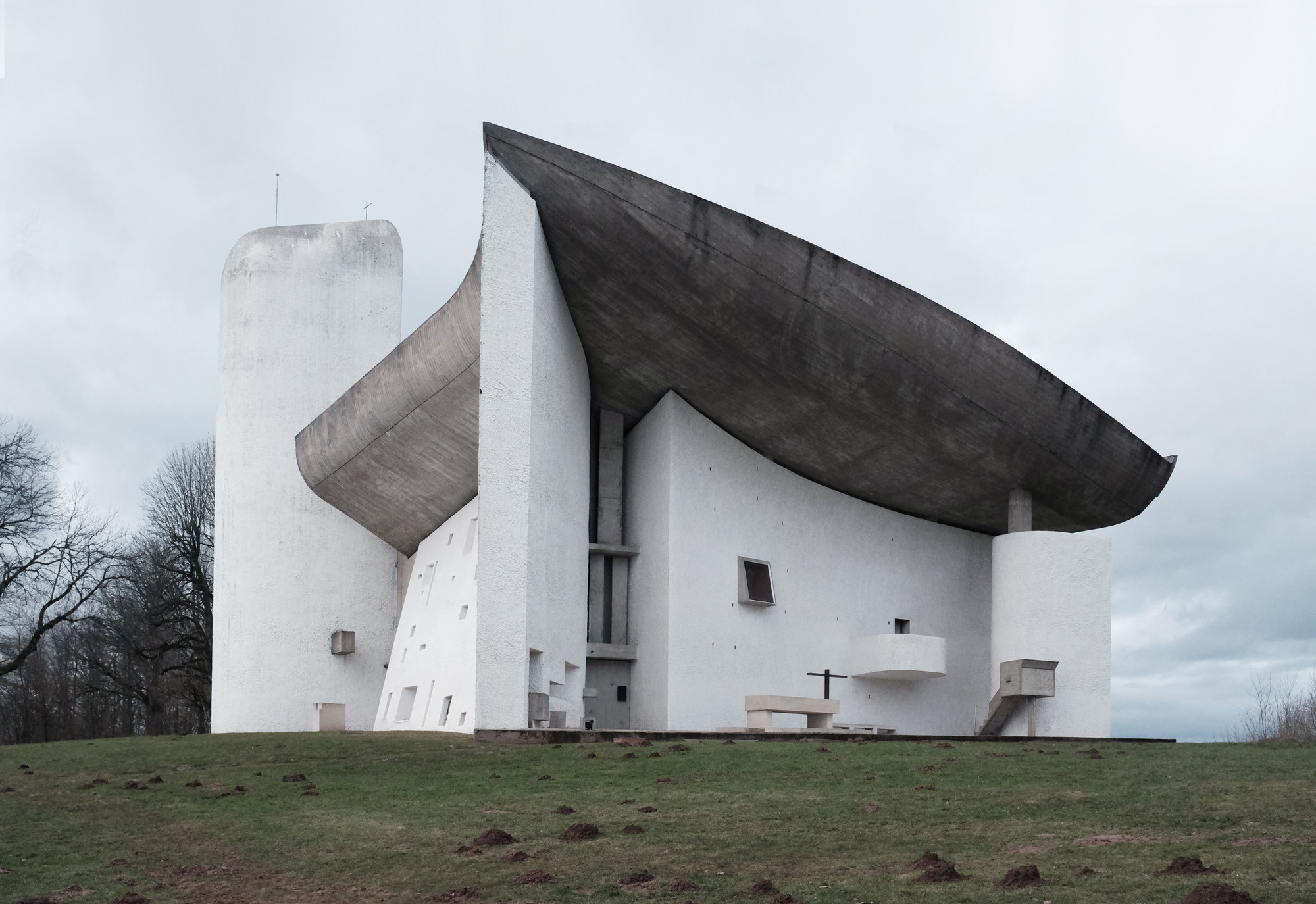
     Notre Dame du Haut, Le Corbusier, 1955

    The first important work which has considerably influenced contemporary architecture was a small pilgrimage chapel in Ronchamp designed by Corbusier. What looks like an abstracted cottage from a distance, with whitewashed walls and a strangely curved roof, becomes an architectural epiphany up close. Le Corbusier’s magnificent design—from the bent roof that creates a natural fountain when it rains, to the overall sculptural form—make it a celebrated outlier in his career. A wall with small slits and squares cut for light produces a glittering, spiritual calm when viewed from inside.
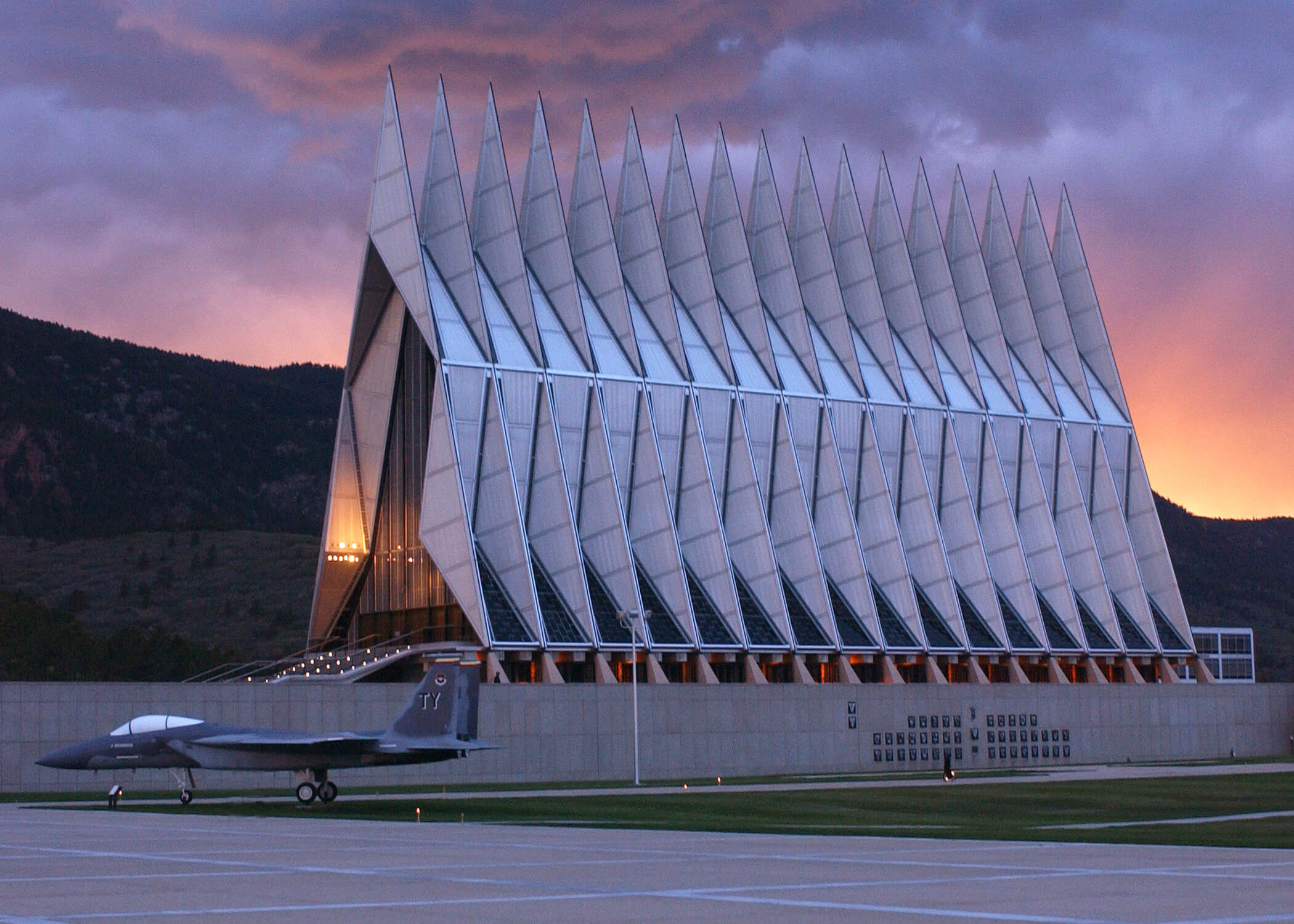
     

    Cadet Chapel, Walter A. Netsch Jr., 1959

    Looking more like a space-age battleship than a house of worship from certain angles, architect Walter A. Netsch Jr.’s futuristic temple is an angular assemblage of five-ton metal tetrahedrons, built out of the same aluminum panels as jet fighter wings. Winner of the American Institute of Architects’ 25 Year Award and a United States National Historic Landmark, the set of 17 spires might as well be a squadron screaming towards the heavens.

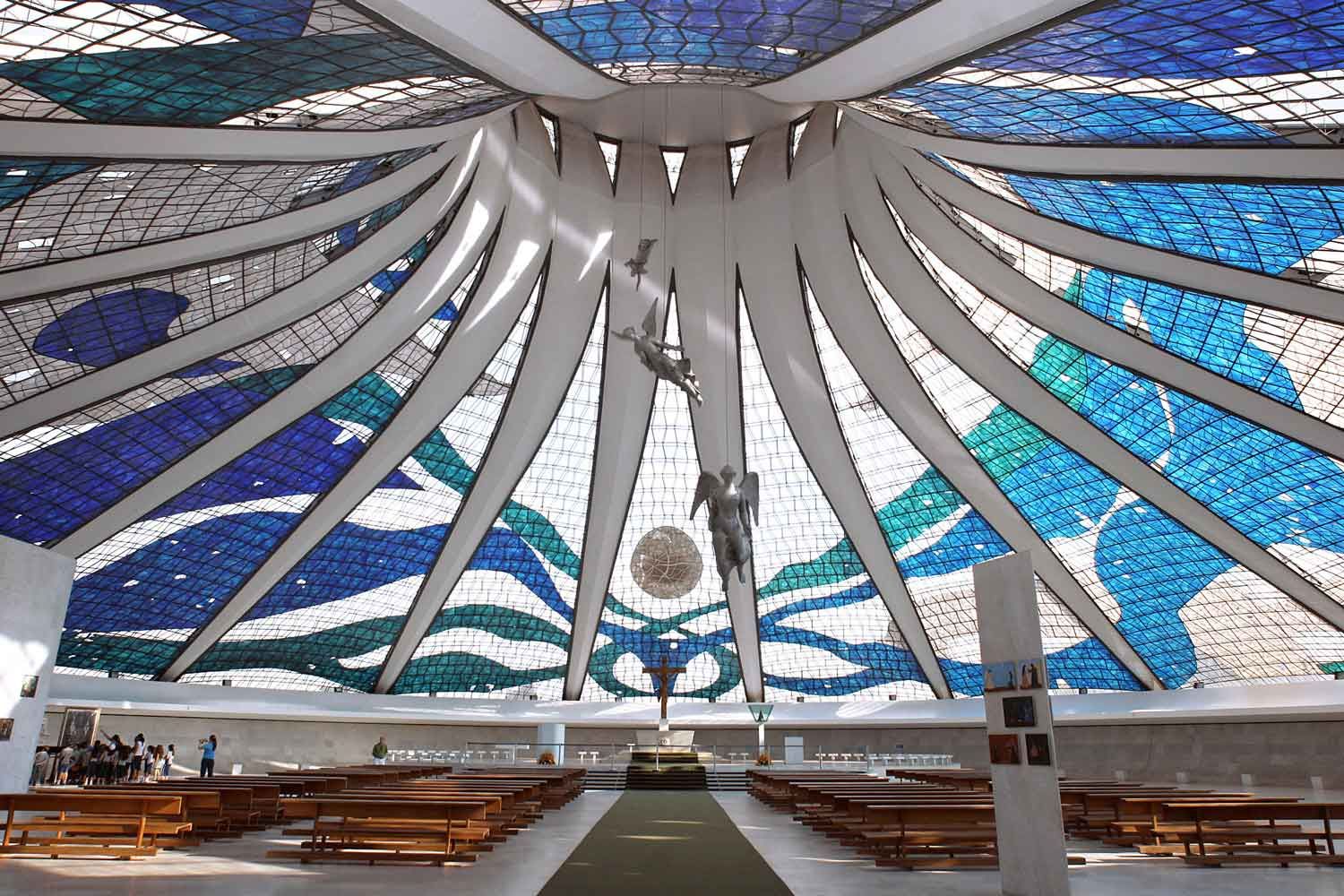
    Cathedral of Brasilia, Oscar Niemeyer, 1960

    Designed by the acclaimed brazilian architect Oscar Niemeyer, the Cathedral of Brasília is an almost crown-like hyperboloid structure that appears pinned to the ground. The building’s appearance, with its striking shape and gorgeous stained glass ceiling, is just as intriguing as its history. Reaching up towards the sky to represent two hands, the columns have parabolic sections.

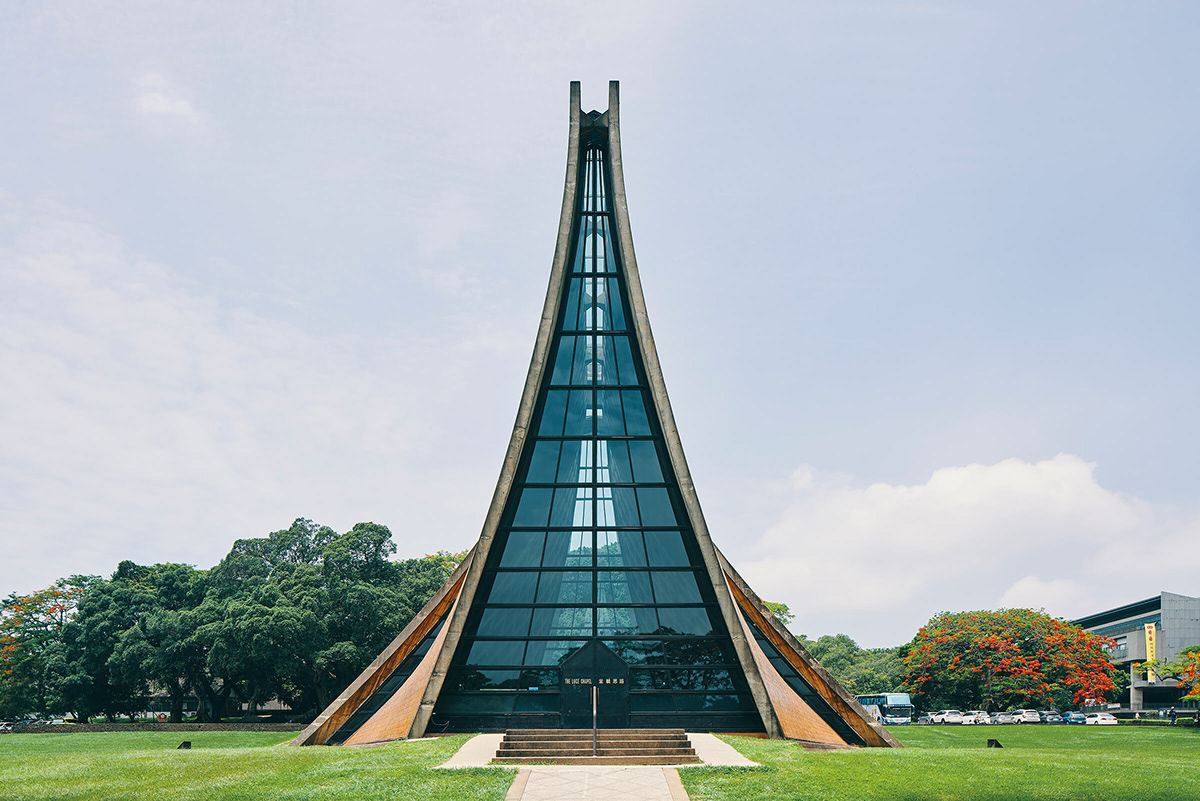
    Luce Memorial Chapel, I.M. Pei, 1963

    When architect I.M. Pei designed this chapel for Tunghai University in Taiwan, he had to take local conditions, like typhoons and earthquakes, into account. His plan, which, included a curved roof of glazed, diamond-shaped tiles and interior ribs of reinforced concrete that run like ribbons towards the cross mounted on the roof, was an elegant solution to the challenges of the local environment.

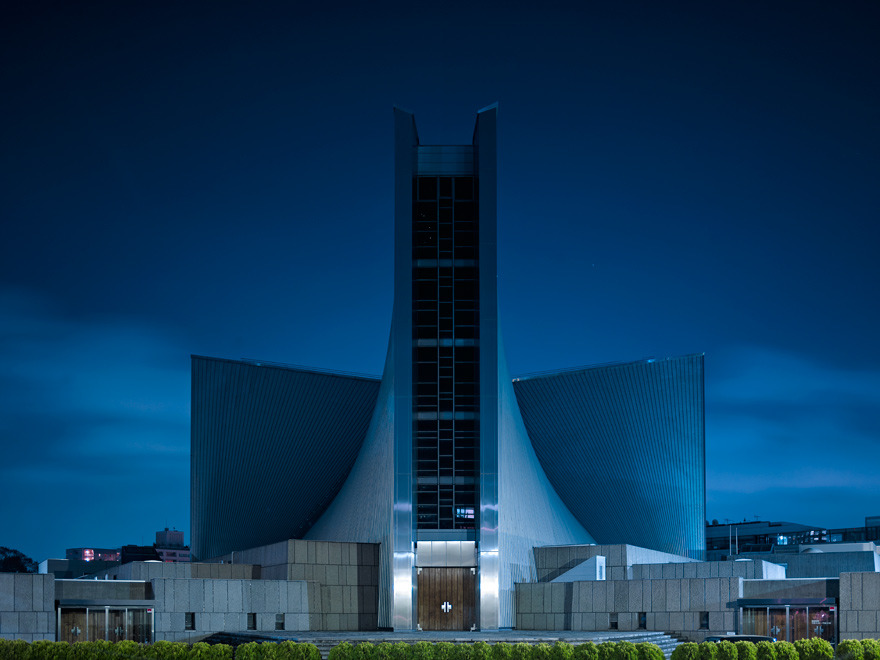
    Saint Mary’s Cathedral, Kenzo Tange, 1964

    There are some buildings that do not belong to any time or age. The Saint Mary Cathedral of Tokyo by Kenzo Tange is definitely one of these. Of course materials and technologies make it recognizable as a project of the 20th century, but we could easily say that this project has been built yesterday the same as 50 years ago. It’s not usual, in terms of the quality of architecture. And it is not the only quality of this project. The Tokyo Cathedral has been completed in 1964, replacing the old wooden cathedral, in gothic style, burnt during wartime. Tange conceived the new church as a concrete structure, simple in concept and complex in shape, which recalls the lightness of a bird and its wings.

    Photo by Flickr user C. Strife

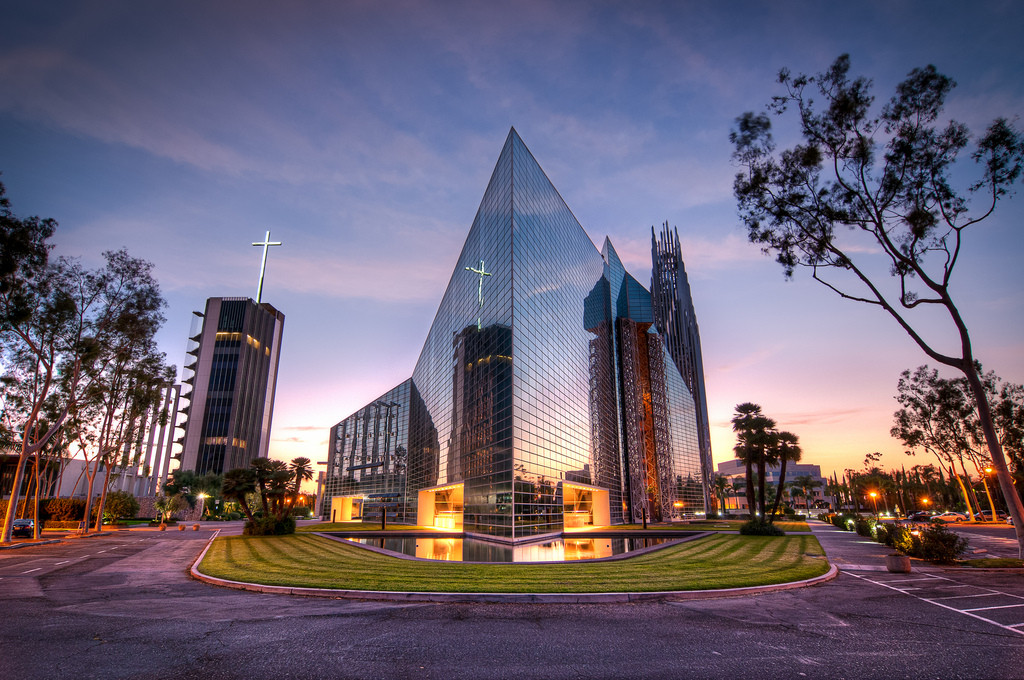
    Crystal Cathedral, Philip Johnson, 1981

    Home to the massive congregation of preacher Robert Schuller, famous for the Hour of Power television show, the Crystal Cathedral certainly puts the mega in megachurch. Philip Johnson and John Burgee devised the glass enclosure in response to Schuller’s request that the church be open to the “sky and the surrounding world.” The facade is composed of more than 10,000 glass panels affixed to a framework of steel trusses. Johnson and Burgee developed the angular, star-shaped plan to enliven the monolithic, monochromatic volume. The steel tower was also designed by Johnson and completed in 1990. It is visible across the 34-acre campus and serves as a vertical counterpart to the Cathedral.

    Photo by Daniel Williams

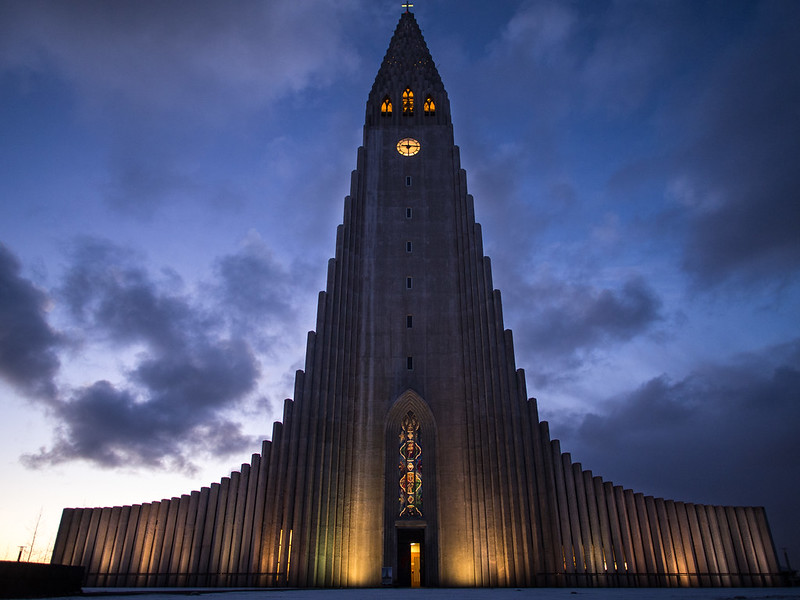
    Hallgrímskirkja, Reykjavík, Guðjón Samúelsson, 1986

    Reykjavík’s largest church was designed by Guðjón Samúelsson, one of Iceland’s most notable modernist architects who worked on a number of state projects. Situated at the top of a hill in the capital, Hallgrímskirkja took 41 years to construct.

    The building presents a staggered fluted facade to a principle axis through the city centre, which terminates at its door. It is topped with a triangular bell tower that visitors can climb for panoramic view across Reykjavík and its harbour. Its interior is an austere grey space with barely any ornamentation, apart from a giant geometric pipe organ mounted high on the front wall.

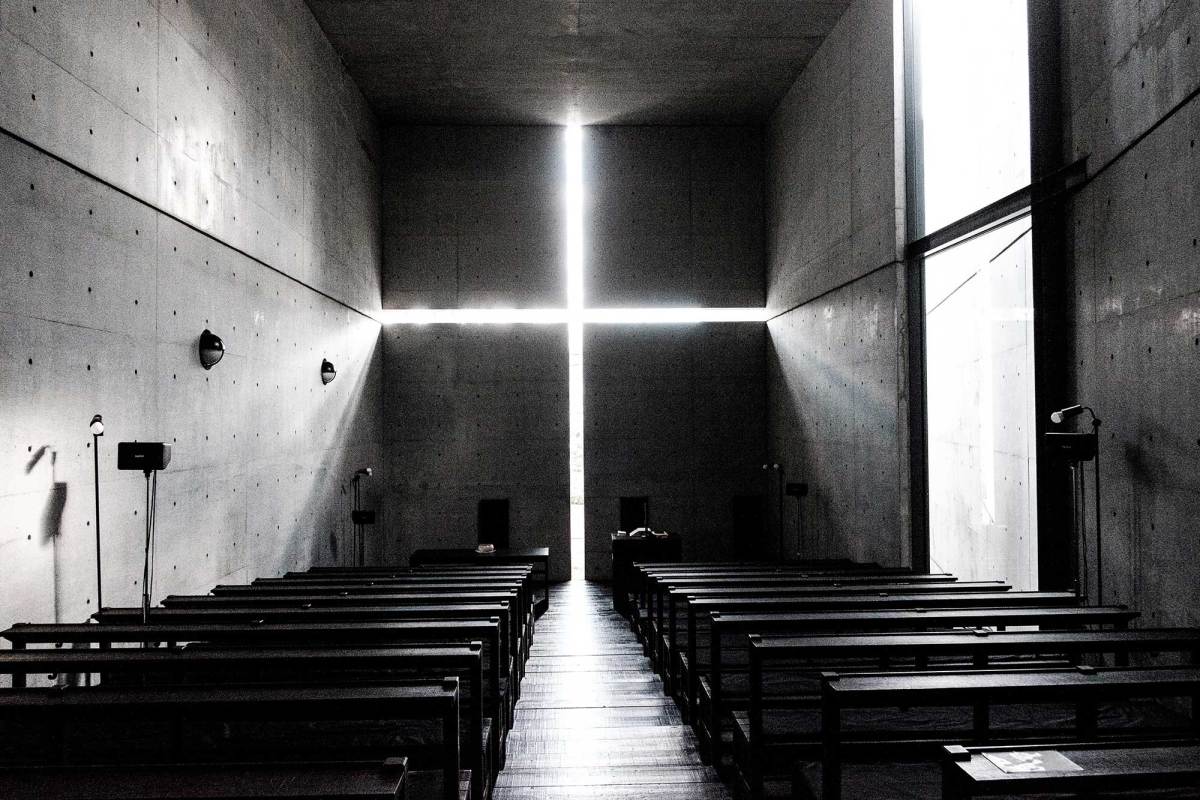
    Church of the Light, Tadao Ando, 1989

    Tadao Ando’s Church of the Light was built in 1989 in a small town just outside of Osaka, Japan and it still remains one of his most remarkable works of architecture. The church beautifully showcases the duality of solid and void, as well as light and dark.

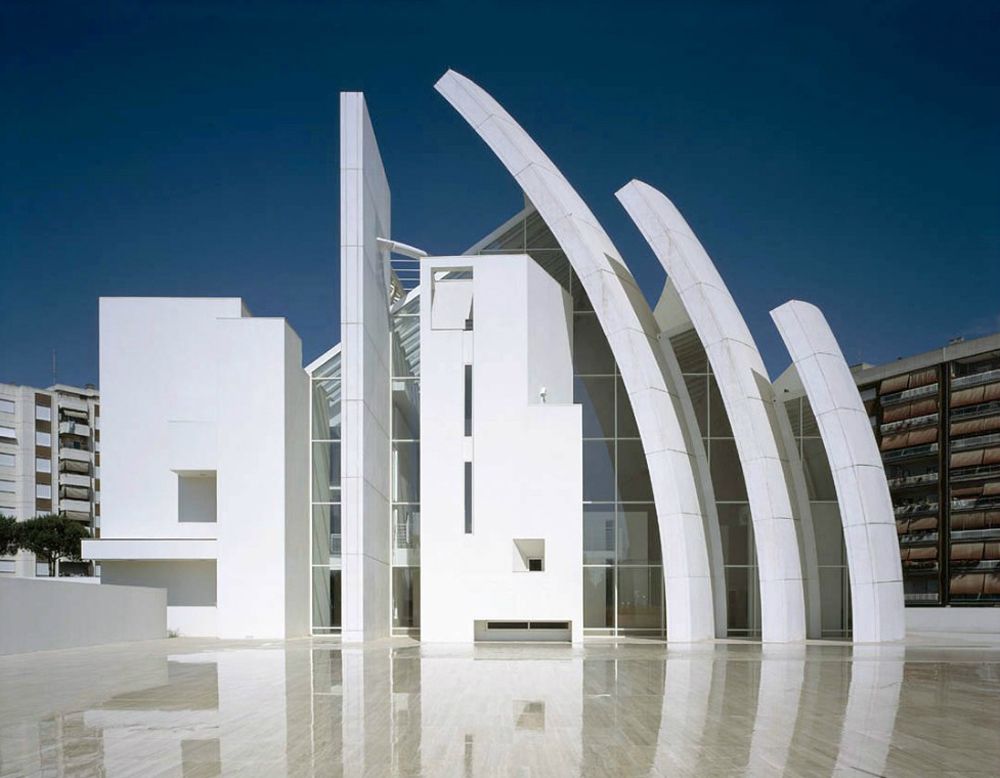
    Jubilee Church, Richard Meier, 1996

    American architect Richard Meier won a design competition held by the bishop of Rome to create a church for the far suburbs of the Italian capital. Meier’s design recalls ships in a harbor, with three airy sails of self-cleaning concrete fanning out from the main chapel. Most miraculous, perhaps, is that the company that developed the special concrete for this project suggested that the material actually fights pollution and absorbs noxious chemicals in car exhaust.

    Source: dwell.com; design-milk.com; archdaily.com

    Të fundit

    VLORA INTERNATIONAL AIRPORT

    XPLAN STUDIO
    • Public Architecture

    Sunny Hill Apartment

    Studio27
    • Interior design

    Ioanian Coast Minimal Villa

    andoni studio
    • Villa
    • +2
    Të rejat

    Elevate Your Design Vision: 5 Reasons to Choose Art House Academy

    15/11/2025

    Architecture and AI with Matthias Hollwich :A Meeting with the Future

    12/11/2025

    5 reasons to “Smart” with SMART HOME ALBANIA

    08/11/2025
    Punësim

    Bregu sha- Senior Architects

    • +355698040360
    • Full time

    Arkonik- architect

    • Full time

    Castellino Home : Architect

    • +355693850769
    • Full time
      About
      • About Us
      • T: +355 682079978
      • Contact
      Follow us
      • Facebook
      • Instagram
      • Linkedin
      Join us
      • Join in as an Architect
      • Join in a Business
      • Privacy Policy
      • About Us
      • T: +355 682079978
      • Contact

      Cart

        • Facebook
        • Twitter
        • WhatsApp
        • Telegram
        • Pinterest
        • LinkedIn
        • Tumblr
        • VKontakte
        • Mail
        • Copy link